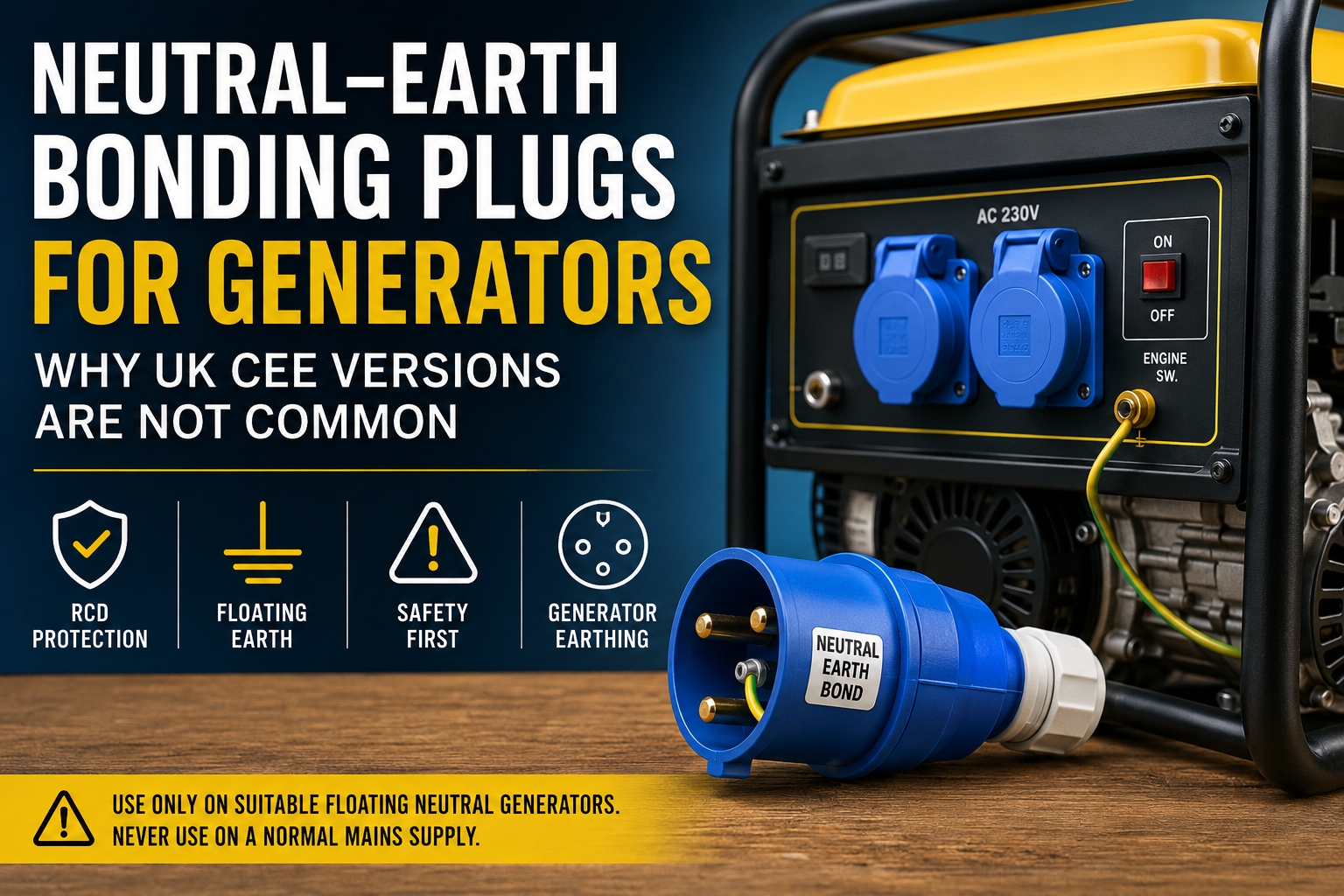
Neutral–Earth Bonding Plugs for Generators: Why UK CEE Versions Are Not Common
A customer recently asked whether a neutral–earth bonding plug would make the RCD work on a portable generator. It sounds like a simple adapter question, but it is really a generator earthing and protection question.
A neutral–earth bonding plug can be correct in one very specific generator arrangement. Used in the wrong place, it can create a dangerous neutral-to-earth fault.
Important safety note: This article is general guidance only. Generator earthing, neutral bonding and RCD protection should be checked against the generator manufacturer’s instructions and, where necessary, by a competent electrician.
Why do some portable generators have a floating earth?
Many small portable generators do not behave like a normal UK mains supply. Instead of having the generator winding deliberately referenced to earth, the output may be what people commonly call floating.
In a floating generator arrangement, there may be no connection between the generator winding and the earth contact of the socket outlet. The earth contact may simply be connected to the generator frame.
In plain English: the generator may have a live and neutral output at the socket, but the earth pin may not provide the same fault return path that people expect from a normal fixed electrical installation.
Why might an RCD tester not trip on a floating generator?
A standard RCD detects imbalance. It compares the current going out on live with the current returning on neutral. If some current leaks away through earth, the RCD sees the difference and trips.
But on a floating generator, a plug-in RCD tester may not have a proper return path through earth. The tester may try to send a small fault current from live to earth, but if the generator output is not referenced to earth, the test may not work as expected.
That does not automatically mean the RCD is faulty
If a plug-in socket tester fails to trip an RCD on a floating generator, the issue may be the generator’s floating output rather than a defective RCD.
However, if the RCD’s own built-in TEST button does not work, that is a different concern and the RCD, wiring or generator arrangement should be checked properly.
What does a neutral–earth bonding plug do?
A neutral–earth bonding plug links the neutral conductor to the earth conductor inside a plug or adapter.
On the correct type of floating generator, this can create a defined neutral-earth reference. That may allow RCD protection to operate more like it does on a conventional earthed supply, because a live-to-earth fault now has a return path.
But the bond has to be appropriate for the generator, positioned correctly in the system, and used with suitable protection.
The problem is not making a plug.
The problem is knowing whether that plug is safe for the generator, the RCD, the load and the installation it is being used with.
Why are US generator bonding plugs common?
Neutral-ground bonding plugs are common in the US portable generator and RV market. Many American inverter generators use NEMA sockets, and some RV surge protectors or EMS units expect to see a neutral-ground bond before they allow power through.
That has created a market for small NEMA bonding plugs designed for particular generator/RV situations.
In the UK and European CEE world, the same idea is treated much more cautiously. A blue CEE plug with neutral and earth linked inside is not just a harmless adapter. It changes the earthing arrangement of the supply.
Why are UK CEE neutral–earth bonding plugs hard to find?
The main reason is misuse risk.
A UK CEE neutral–earth bonding plug could easily be plugged into the wrong supply. Someone might use it on a normal mains socket, a campsite hook-up, a distribution board, a caravan supply, or a generator that is already internally bonded.
- It may create a neutral-to-earth fault.
- It may cause RCDs to trip unexpectedly.
- It may put neutral current onto protective earth conductors.
- It may defeat or interfere with the intended generator safety arrangement.
- It may be dangerous if used on a generator that the manufacturer says must not be bonded.
What happens if a neutral–earth bonding plug is plugged into a normal house socket?
It should not be done.
In a normal UK electrical installation, neutral and earth are already dealt with at the correct point in the supply arrangement. Adding another neutral-earth link downstream at a socket outlet can create a fault condition.
It will not usually make the earth system “live” at 230V in the same way as the line conductor, because neutral is normally close to earth potential. But it can make the protective earth conductor carry current that should be returning through the neutral conductor.
That is the danger: the protective earth conductor is meant to be a safety path during fault conditions, not a normal current-carrying conductor.
Is an earth rod the same as a neutral–earth bond?
No. This is a common misunderstanding.
An earth rod connects equipment to the general mass of earth. A neutral–earth bond connects the generator’s neutral point to the protective earth system.
Depending on the generator design, simply adding an earth rod may not make an RCD operate as expected. The complete fault path has to make electrical sense, and the generator manufacturer’s instructions matter.
Earth rod
Connects to the physical ground. It may be required in some generator arrangements, but it is not a universal fix.
Neutral–earth bond
Creates a reference between neutral and earth. It must only be used where the generator arrangement permits it.
When could a neutral–earth bond be appropriate?
A neutral-earth bond may be appropriate where the generator is confirmed as a suitable floating-neutral generator and the manufacturer allows that arrangement.
It may also be part of a professionally designed temporary distribution setup using RCD or RCBO protection.
But it should not be treated as a universal plug-in fix for every generator.
- The generator type should be confirmed.
- The manufacturer’s instructions should allow neutral-earth bonding.
- The generator should not already be internally bonded.
- The RCD should be correctly positioned and suitable for the arrangement.
- The load and distribution setup should be considered as a complete system.
- The bonding device must never be used on a normal mains supply.
When should a neutral–earth bonding plug not be used?
A neutral–earth bonding plug should not be used where the generator or supply arrangement is unknown.
It should also not be used as a workaround for a faulty RCD, damaged cable, incorrectly wired generator, or badly designed temporary installation.
- Do not use one on a normal UK mains socket.
- Do not use one on a campsite hook-up or building supply.
- Do not use one on a generator that is already neutral-earth bonded.
- Do not use one on an inverter generator unless the manual clearly permits it.
- Do not use one to feed a house, caravan or consumer unit without proper electrical design and testing.
Why MotorCables does not sell a universal UK CEE bonding plug
At MotorCables, we manufacture and supply heavy-duty power cables and adapters, but a neutral–earth bonding plug is not just another adapter.
The cable itself is not the hard part. The risk is the unknown generator, the unknown RCD position, and the unknown installation.
Our position:
We do not recommend a universal “one size fits all” UK CEE neutral–earth bonding plug because the same plug could be safe in one specific generator arrangement and unsafe in another.
If a generator RCD is not behaving as expected, the safer approach is to identify the generator type, check the manual, confirm whether the generator is floating or already bonded, and test the complete setup correctly.
Safe customer advice
If your generator RCD is not working as expected, do not assume the answer is simply to buy a bonding plug.
Check these points first
- Does the RCD’s own test button work?
- Is the generator floating neutral or bonded neutral?
- Does the generator manual allow neutral-earth bonding?
- Is the RCD tester giving a misleading result because the generator output is floating?
- Is the generator supplying one appliance, multiple appliances, or a fixed installation?
- Has the complete setup been checked by a competent electrician?
MotorCables safety note
We do not supply universal neutral–earth bonding plugs for generators because they can be dangerous if used on the wrong supply. If you believe your generator requires a neutral–earth bond, please check the generator manual or consult a competent electrician before using any bonding device.
Authoritative references
- IET Wiring Matters: Operation of Portable Generators
- HSE: Electrical Safety of Independent Low-Voltage AC Generators
- BEAMA: RCD Handbook
Generator Neutral–Earth Bonding Plug FAQs
What is a neutral–earth bonding plug for a generator?
A neutral–earth bonding plug is a plug or adapter that links the neutral conductor to the earth conductor. On certain floating-neutral generators, that link can create a defined neutral-earth reference for RCD protection. It must only be used where the generator arrangement allows it.
Why does an RCD tester fail to trip on a floating generator?
A plug-in RCD tester often works by leaking current from live to earth. On a floating generator, the earth path may not return properly to the generator winding, so the tester may not create the imbalance needed to trip the RCD.
Does a failed plug-in RCD test mean the generator RCD is faulty?
Not always. A failed plug-in tester result may be caused by the generator’s floating output. However, if the RCD’s own built-in test button does not operate, the RCD, wiring or generator arrangement should be checked.
Can a neutral–earth bonding plug be used on a UK house socket?
No. A neutral–earth bonding plug should not be used on a normal UK mains socket. It can create a neutral-to-earth fault and may cause protective earth conductors to carry current.
Why are UK CEE neutral–earth bonding plugs not common?
UK CEE neutral–earth bonding plugs are not common because they can be easily misused. The same plug could be used correctly on one specific generator arrangement but dangerously on a normal mains supply, campsite hook-up, distribution board, caravan supply or already-bonded generator.
Is an earth rod the same as a neutral–earth bond on a generator?
No. An earth rod connects equipment to the physical ground. A neutral–earth bond connects the generator neutral to the protective earth system. Depending on the generator design, adding an earth rod alone may not make RCD protection work as expected.