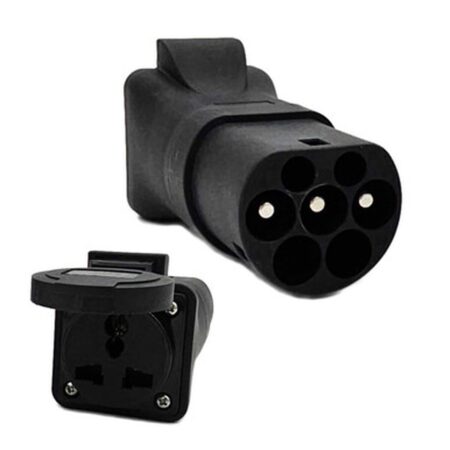
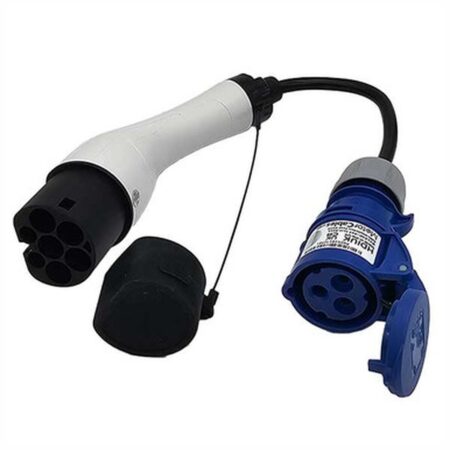
EV means electric vehicle. An EV adapter changes a connection for a particular charging or power application. Some products help connect a vehicle for charging, while others provide auxiliary power or an interface for testing; those jobs are different.
“EV adapter” can describe several different products. A cable for charging a vehicle, an adapter for taking auxiliary power from a compatible charge point and an electrician’s test adapter have different jobs. Start by identifying which job you need the product to perform.
Three different applications
Charging an electric vehicle
Use the charging equipment and connections permitted by the vehicle and charger manufacturers. An auxiliary Type 2-to-CEE power adapter is not, by itself, a complete vehicle charger. Check the instructions for the exact equipment rather than treating all adapters or extension leads as approved charging accessories.
Auxiliary power from a compatible Type 2 AC charge point
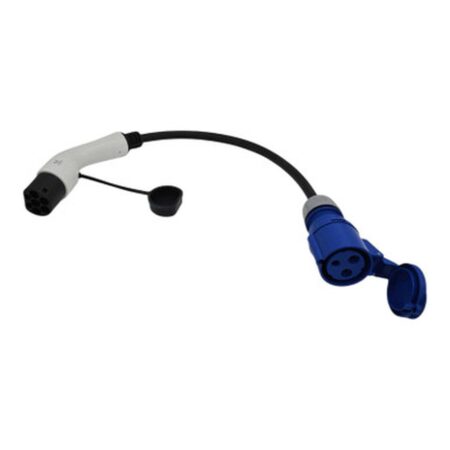
Our Type 2 to CEE 230V 16A converter is described as an auxiliary power adapter with a blue CEE socket. Its role is to supply suitable equipment from a compatible Type 2 AC charge point, subject to the product specification, supply arrangements and operator’s permission.
The 16A three-phase Type 2 converter has a different output arrangement. It is not interchangeable with a single-phase caravan hookup simply because both products have a 16A rating. Select against the equipment’s actual supply requirement.
Testing EV charging equipment
The EVSE socket and tethered-cable tester is intended for competent people using appropriate electrical test equipment. Its test connections are not general-purpose appliance outlets. A functional adapter check is not a substitute for the full installation tests required for a charging system.
Check compatibility before ordering
- The exact charge-point model and whether it is a socket or tethered arrangement.
- Whether the charge-point operator permits the intended auxiliary-power use.
- The output voltage, phase arrangement, connector and current required by the equipment.
- The rating of the complete adapter, any associated leads and the connected load.
- The product instructions and the site’s electrical protection requirements.
A charge point’s advertised maximum power is not a promise that every adapter or connected appliance can use it. Read the specific converter listing and confirm compatibility; do not assume universal operation across public charging networks.
Where CP and PP fit in
Type 2 charging connections include signalling contacts as well as power contacts. CP means Control Pilot; PP means Proximity Pilot. These are part of the charging connection’s signalling arrangements, not spare general-purpose power connections. Phoenix Contact’s charging-technology documentation explains the terminology.
Do not modify pilot circuits or use a generic wiring diagram as a compatibility test. Use a purpose-designed product with instructions for the intended application.
Find the right product information
Browse Type 2 socket converters for the available configurations. For leisure-vehicle connections, also read Motorhome and Caravan Hookup Leads. For identification help, Ask Ashford; include the exact charger and equipment models in a bespoke enquiry.
Further guidance
- Phoenix Contact: Charging technology for e-mobility, including its glossary.
- The instructions supplied with your adapter, charger and vehicle. For Tesla equipment, use the official charging product guides for the applicable model.
Understand the connection signals: EV charging CP and PP explained — Control Pilot, Proximity Pilot and current limits.
Read our guide: Adjustable portable EV chargers for home and travel.