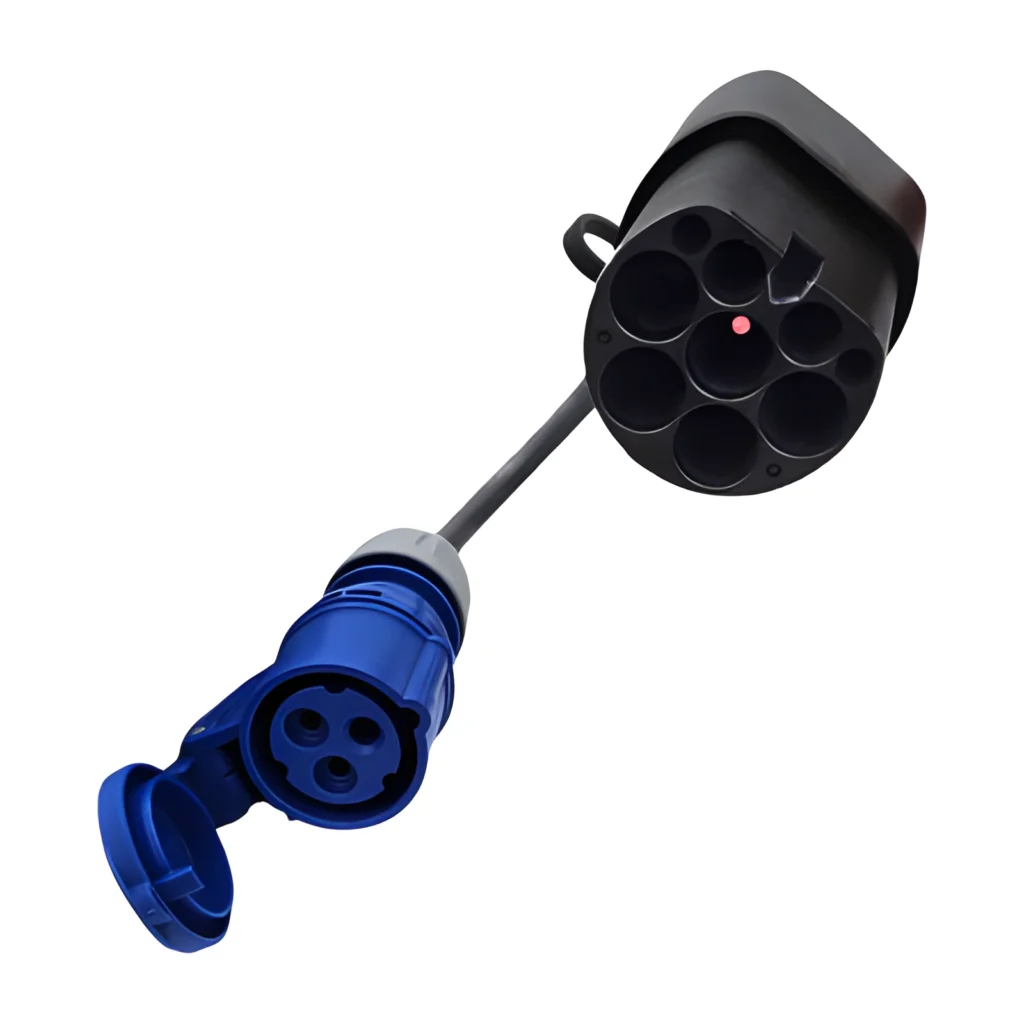
A Type 2 auxiliary power adaptor gives suitable 230V equipment a mains connection at a compatible socketed Type 2 AC charge point. Choose a blue CEE 16A socket or PowerCON TRUE1 output to match your equipment. It can be useful for motorhome leisure-battery chargers, caravans, catering trailers, coffee vans and other mobile equipment where the charge-point operator permits auxiliary-power use.
MotorCables offers white, black and 2-metre CEE versions, plus a PowerCON TRUE1 version. Choose the output connection and reach that suit your equipment. The versions in this guide are rated at 16A maximum.
Portable auxiliary use: This is an auxiliary power cable for portable, temporary use with suitable equipment. It is not intended for a permanent fixed installation. The intended connected load is no more than 16A, and must also respect any lower limit of the complete setup.
Choose a 16A Type 2 auxiliary power adaptor
-
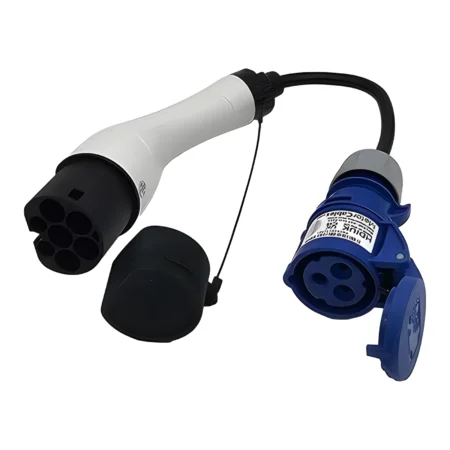
EV Type 2 to CEE 230 Volt 16A Socket Power Supply Converter (white)
£104.99 Add to basket -
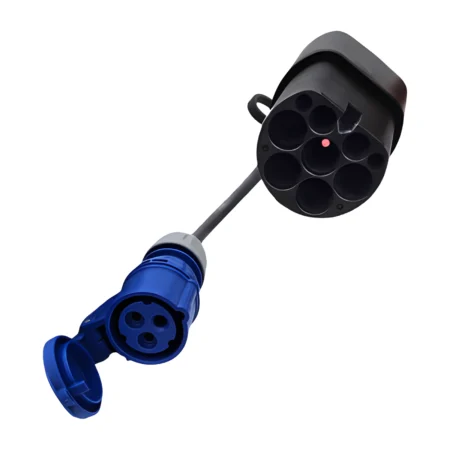
EV Type 2 to CEE 230 Volt 16A Socket Power Supply Converter.
£109.99 Add to basket -
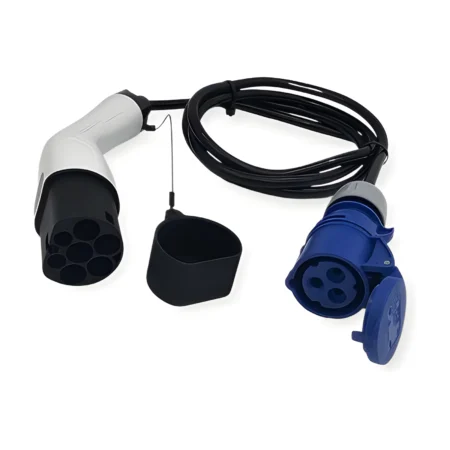
2 Metre EV Type 2 to CEE 230 Volt 16A Socket Power Supply Converter
£129.99 Add to basket -
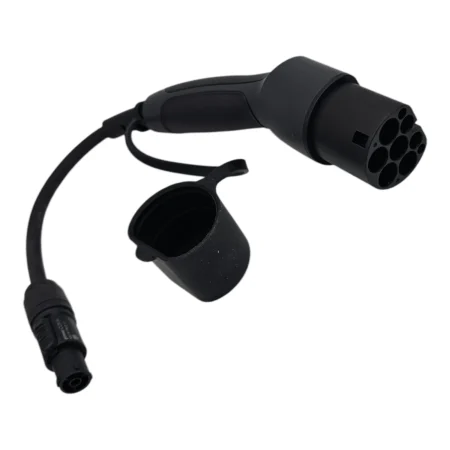
Type 2 EVSE Plug to PowerCON TRUE1 Auxiliary Power Adapter 16A (230V AC)
£119.99 Add to basket
The compact CEE versions suit users who already carry a suitable hookup lead. The 2-metre version provides additional reach in the adaptor itself. Product pages show current prices, availability and the specification of each version.
CEE or PowerCON TRUE1: which output do you need?
| Version | Output | Typical connection |
|---|---|---|
| White, black or 2-metre CEE adaptor | Blue CEE 16A, single-phase 230V socket. | A suitable motorhome, caravan or catering hookup lead, or other compatible CEE-equipped equipment. |
| PowerCON TRUE1 adaptor | PowerCON TRUE1 connector, rated 16A at 230V AC for this assembly. | Equipment with the matching TRUE1 inlet or a suitable TRUE1 lead, including compatible event, display or lighting equipment. |
Our Type 2 to PowerCON TRUE1 auxiliary adaptor is the alternative when your equipment uses TRUE1 rather than a blue CEE inlet. Its published specification lists 3G2.5 H07RN-F black rubber cable and an integrated CP interface. It is also intended for portable, temporary auxiliary use, with a maximum connected load of 16A.
The TRUE1 connection at the equipment end is separate from the Type 2 connection at the charge point. Check the exact mating inlet or cable connector. For additional reach, see the TRUE1 extension lead; for a suitable change of output connection, see the TRUE1-to-CEE converter. Additional leads or adaptors do not increase the 16A total rating.
What the adaptor actually does
An AC charge point supplies mains electricity rather than the low-voltage DC used inside a battery. The adaptor provides the connection and pilot signalling needed to enable a compatible charge point, and brings a single-phase mains feed to the selected CEE or PowerCON TRUE1 output.
For these single-phase adaptors, the power connection uses one phase, neutral and protective earth. A compatible three-phase Type 2 AC supply can therefore provide a single-phase 230V feed; the adaptor does not combine all three phases or transform the voltage.
Your equipment then works from that mains supply in its usual way. To charge a leisure battery, connect the motorhome’s suitable onboard charger or another appropriate 230V battery charger. The adaptor does not connect directly to a 12V battery or replace its charging controls.
PP and CP: cable rating and connection signalling
| Contact | What it communicates | Why it matters |
|---|---|---|
| PP — Proximity Pilot | A coded resistance identifies the detachable cable assembly’s current capability to the EVSE. | The charge point takes the recognised cable rating into account when setting the permitted charging current. |
| CP — Control Pilot | The EVSE advertises available current through a PWM signal. The connected vehicle or compatible interface signals connection and readiness through CP states. | The power contacts are enabled only after the charge point’s required checks and authorisation. |
PP does not measure conductor thickness. It reads a resistor code representing the assembly’s declared capability. Nor does CP carry the mains power. For the wider explanation, see CP and PP explained.
The 16A rating and overload protection
These versions are intended for connected loads totalling no more than 16A. Choose and operate your equipment within that rating, just as you would with any other 16A lead or socket. The complete adaptor remains rated at 16A even where the cable itself has a higher current-carrying capability.
PP coding helps the EVSE recognise the cable capability and set the permitted charging current. In ordinary EV charging, the vehicle controls its draw within the CP allowance. An ordinary mains appliance draws current according to its load, so the equipment you connect must be selected for the adaptor’s 16A rating and any lower supply limit.
IEC 61851-1:2017, clause 13.2, also requires overload protection for the intended charging-cable sizes, provided by the station or upstream protection. That is protection against an overload, rather than a regulated supply holding current at an exact value. Normal intended use keeps the connected load within its rating.
For reference, the standard PP code of 680Ω identifies a 20A cable capability; 220Ω identifies 32A. Those are cable-coding values, not permission to exceed the rating of a 16A output socket. Neither a higher cable rating nor a 7kW or 22kW charge-point label upgrades the complete 16A adaptor.
How much equipment can a 16A version supply?
At nominal 230V, 16A is approximately 3.68kW. Treat that as an upper rating, not a promise of available power. The charge point, supply controls, lead and equipment can impose lower limits.
For example, a 2,000W appliance, 500W battery charger and 100W lighting load total 2,600W, or about 11.3A at 230V for loads operating near unity power factor. Use actual input-current ratings when available, and allow for motor starting current and other equipment characteristics.
A 7kW or 22kW badge on a charge point does not upgrade a 16A adaptor. Likewise, a splitter provides more sockets, not a larger total current allowance. Coffee machines, water boilers, hotplates and heaters can quickly exceed a 16A setup when used together.
Motorhomes, caravans, catering trailers and coffee vans
| Application | What the adaptor can connect | Plan around |
|---|---|---|
| Motorhome or caravan | A suitable hookup connection and onboard mains charger for the leisure battery. | The vehicle installation, inlet, protection and combined mains load. |
| Coffee van or catering trailer | Compatible 230V equipment supplied through a suitable inlet or distribution arrangement. | The total load, starting currents and permission to operate from the bay. |
| Street stall or mobile display | Suitable lighting, refrigeration, signage or other mains equipment. | Cable routing, weather exposure, public access and site rules. |
| E-bike or mobility scooter | The correct mains battery charger for the equipment. | The charger’s input specification and a suitable connection from CEE to its mains plug. |
For smaller device chargers, read charging a phone, laptop or e-bike from an EV point. For vehicle hookup arrangements, see motorhome and caravan hookup leads.
Using public charging networks
These products are intended for compatible socketed Type 2 AC charge points. Use the operator’s normal app, card or payment process to authorise a session where required. Public-network availability can make a permitted auxiliary-power connection useful when travelling or working away.
Compatibility and permission are separate checks. An operator may restrict a bay to EV charging, and some charge points require connection, locking, minimum-load or communication behaviour that an auxiliary adaptor does not provide. We do not promise operation on every public network. These socketed versions are not a universal solution for tethered connectors, CCS or CHAdeMO DC chargers.
Why our Type 2 plug needs no separate release button
Our nonlocking Type 2 plug design does not need a separate release button. The charge-point end uses a grooved plug profile rather than relying on an additional release control. There is no extra release switch for the user to operate.
This is a design feature of these auxiliary adaptors, not a claim that every Type 2 accessory works in the same way. A separate button is not, on its own, evidence that an adaptor is better or more reliable. The TRUE1 locking connection at the equipment end is a different mechanism from releasing the Type 2 plug at the charge point.
When finished, switch off the connected equipment, stop the session using the charge point’s normal controls and disconnect according to the product instructions. If a connector resists removal, follow the operator’s release procedure rather than forcing it.
Can you use a short adaptor with your existing hookup lead?
Yes, with a suitable complete arrangement. A short Type 2 adaptor and a correctly rated outdoor CEE hookup lead can provide the same type of mains connection as a longer assembly. You do not need to buy a long integrated lead just because your existing cable uses matching blue CEE connectors.
The extension needs the correct plug and coupler, adequate conductor size for its length and load, and a suitable cable and environmental rating. Every extra connection needs sound mating contacts and appropriate protection from weather and damage. Fully unwind the lead, inspect it before use and check voltage drop on longer runs.
Browse 16A extension leads and read our voltage drop guide. A domestic indoor extension lead is not a substitute for an appropriate outdoor hookup lead.
Arctic cable, Titanex and tarmac: what actually matters?
Touching tarmac does not, by itself, make an appropriately specified outdoor lead unsuitable. Nor does the word Titanex, by itself, settle whether a complete connection is suitable. The cable specification, handling, condition and expected exposure matter.
Arctic-grade PVC cable is available for outdoor and low-temperature applications. H07RN-F is a heavy-duty rubber cable designation; TITANEX is Nexans’ branded range. They are different constructions with different published performance. Do not assume that all Arctic cables have the abrasion, oil or weather resistance of a particular rubber cable.
For an ordinary temporary setup, choose cable suitable for the actual conditions. For repeated dragging over rough ground, demanding handling, oil exposure or a site requiring H07RN-F, choose a specification meeting those demands. Avoid dragging either type across sharp edges, trapping it under wheels or exposing it to hot surfaces. Route leads away from traffic and manage trip hazards.
There is no basis for a blanket claim that only one cable brand can be used on all car-park surfaces. Equally, no cable is damage-proof. Compare the specifications in our Arctic, H07RN-F and TITANEX guide and check the requirements of the particular site or installation.
Choosing a dependable setup
Start with the right connector, the published current rating, an appropriate lead and equipment in good condition. Choose the compact or 2-metre adaptor for practical reach, not on the assumption that longer automatically means safer.
Each product page provides its specification and current availability. You can also read the customer review on the standard converter product page or ask us about your intended connection.
Technical references and further reading
- IEC 61851-1:2017: pilot signalling, cable coding and clause 13.2 overload protection.
- Texas Instruments EVSE design guide: CP duty cycle and the vehicle’s current allowance.
- Phoenix Contact charging-controller documentation: current settings and configurable overcurrent monitoring.
- DEKRA EVBox test report 2251712.60: clause 13.2 tests, including cable coding. This describes the tested station, not a test of MotorCables adaptors.
- Eland Arctic-grade cable specification and H07RN-F specification: example cable constructions and applications.
Technical references checked 12 November 2026. For other connection types, see EV charging adaptor applications.