A flexible power cable contains insulated copper conductors inside a protective outer sheath. Arctic-grade PVC and H07RN-F rubber cable are two options used in power leads, but their materials and published performance differ. This CableSpec guide helps buyers understand those differences before choosing a lead for work, events or leisure.
Quick answer: Arctic flex is designed to retain flexibility in low temperatures. H07RN-F is a heavy-duty flexible cable designation; TITANEX® is Nexans’ branded H07RN-F range. Compare the exact cable specification and the complete lead, including its connectors and intended use.
Technical references checked: 4 November 2026. The figures below describe the identified reference products, not a certification of every cable sold under a similar name.
Arctic PVC versus H07RN-F at a glance
| Detail | Arctic-grade PVC reference | H07RN-F / TITANEX reference |
|---|---|---|
| Published datasheet example | 318-A Arctic-grade PVC; datasheet source: Eland Cables | Nexans TITANEX H07RN-F 3G4, ref. 10055534 |
| Insulation and sheath | Arctic-grade polyvinyl chloride (PVC) | Cross-linked elastomer; commonly described as rubber cable |
| Conductor | Class 5 flexible copper | Class 5 flexible copper |
| Cable voltage rating | 300/500 V | 450/750 V |
| Temperature detail | Eland specifies −40°C to +60°C for fixed use | Nexans specifies a maximum conductor service temperature of 90°C for this product |
| Main specification to check | Low-temperature handling and the permitted application | Handling duty, environmental resistance and the exact manufacturer’s limits |
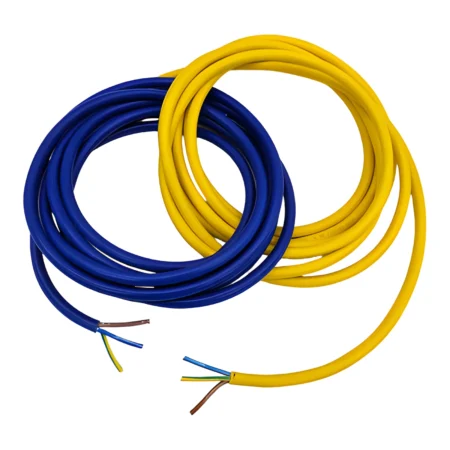
| Colour | The reference range offers blue or yellow | The reference product has a black sheath |
The temperature entries describe different measurements: a fixed-use range and a conductor-temperature limit. They are not directly interchangeable ambient operating ranges. Check the exact datasheet for moving use, installation temperature and any limits imposed by connectors.
What is Arctic-grade cable?
Arctic-grade cable is a flexible power cable with specially formulated PVC insulation and an outer PVC sheath designed to retain flexibility in cold conditions. It is available with blue or yellow sheathing.
To identify the cable, read the markings printed along its sheath for the cable type, number of cores and conductor size. A blue or yellow sheath on its own does not confirm that a cable is Arctic grade or establish its current rating.
Temperature figures also need context. A fixed-use temperature rating applies when the cable remains in position. The permitted temperature for moving or repeatedly bending it may differ. The Arctic temperature range in the comparison table is a fixed-use figure from the cited reference datasheet.
What does H07RN-F mean?
H07RN-F is a harmonised cable designation. It describes a construction and voltage class rather than one manufacturer’s product. The characters use the number 0 in H07, rather than the letter O.
| Marking | Meaning |
|---|---|
| H | Harmonised cable designation |
| 07 | 450/750 V voltage class |
| R | Rubber-type insulation |
| N | Polychloroprene or equivalent outer-sheath material |
| F | Flexible conductor construction |
Eland describes H07RN-F as a trailing-duty cable designed for mechanical, thermal and chemical stresses. The precise temperature, resistance and installation claims still belong to the manufacturer’s particular product.
Is TITANEX the same as H07RN-F?
TITANEX is a Nexans brand; H07RN-F is the designation. An H07RN-F cable from another manufacturer is not automatically TITANEX. Look for both the product description and the sheath marking when buying a branded cable.
The cited Nexans TITANEX product publishes oil resistance, outdoor UV resistance and a 90°C maximum conductor service temperature. Those statements do not mean that every H07RN-F cable has identical performance, that every chemical is acceptable, or that a finished plug-and-socket assembly can operate at 90°C.
What do 3G1.5, 3G2.5 and 3G4 mean?
In these markings, the first number is the number of cores, G indicates that a green/yellow protective conductor is included, and the final number is the nominal copper cross-sectional area of each core in square millimetres (mm²). It is not the cable’s outside diameter.
- 3G1.5: three cores, including green/yellow, each nominally 1.5 mm².
- 3G2.5: three cores, including green/yellow, each nominally 2.5 mm².
- 3G4: three cores, including green/yellow, each nominally 4 mm².
The number of cores must suit the circuit. A three-core lead and a five-core lead serve different connection arrangements; a larger copper size does not change the number of available conductors.
Why cable size alone does not give the finished lead’s current rating
Current capacity depends on the cable construction, installation conditions, ambient temperature and number of loaded conductors. Length also matters when assessing voltage drop. Connector and terminal temperature limits can restrict the usable rating even when the cable insulation permits a higher temperature.
A manufacturer’s free-air cable rating is not an instruction to operate a finished extension lead at that current. Use the complete assembly’s stated rating and conditions. Where a lead must meet a site or installation specification, have the selection checked against that specification.
For example, “4 mm² cable” identifies a conductor size. It does not, on its own, confirm the permitted load, maximum length, voltage drop, connector rating or suitability for a particular machine.
For a plain-English explanation of voltage drop and how to calculate it, read our voltage drop guide for beginners. You can also use the voltage drop calculator.
What to check before choosing a lead
- Identify the connection: supply voltage, connector type, number of phases and equipment inlet.
- State the load and length: include continuous operation and any relevant equipment requirements.
- Describe the environment: low temperatures, repeated handling, sunlight, oils and likely mechanical exposure.
- Check the complete assembly: cable marking, core size, connectors, protection and the stated operating limits.
For the application itself, continue with our event and stage power guide, construction-site power guide, motorhome and caravan hookup guide or workshop power guide.
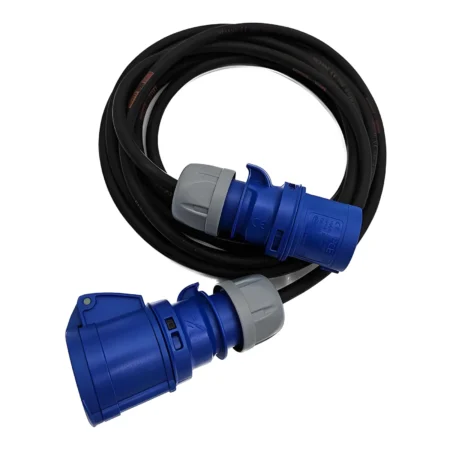
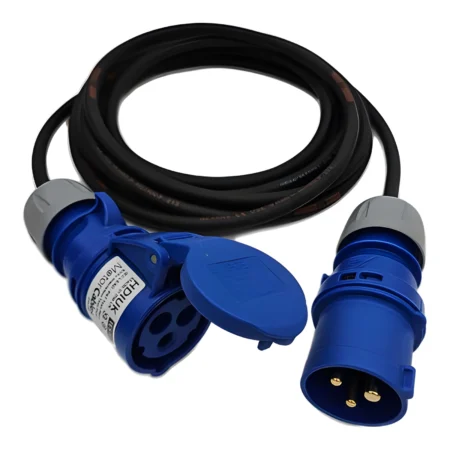
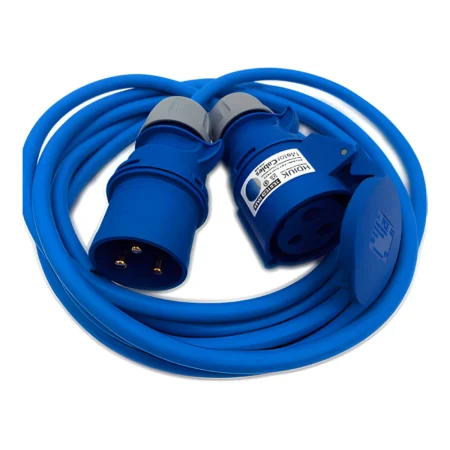
To compare products, see our cut-to-length Arctic cable and 32 A TITANEX extension lead. Check each listing’s own specification. If you need help, send MotorCables the equipment details and required length.
Technical sources
Eland Cables is the supplier publishing the Arctic cable reference datasheet used here. This does not identify the manufacturer or supplier of MotorCables’ own Arctic cable.
These references explain the cable families and the particular example specifications used above. They do not identify the supplier of every MotorCables assembly.