A portable EV charger can be useful both where you normally park and when you travel. The feature that makes it adaptable is adjustable charging current: you can choose an appropriate setting for an approved supply instead of treating every connection as a full-power charging point.
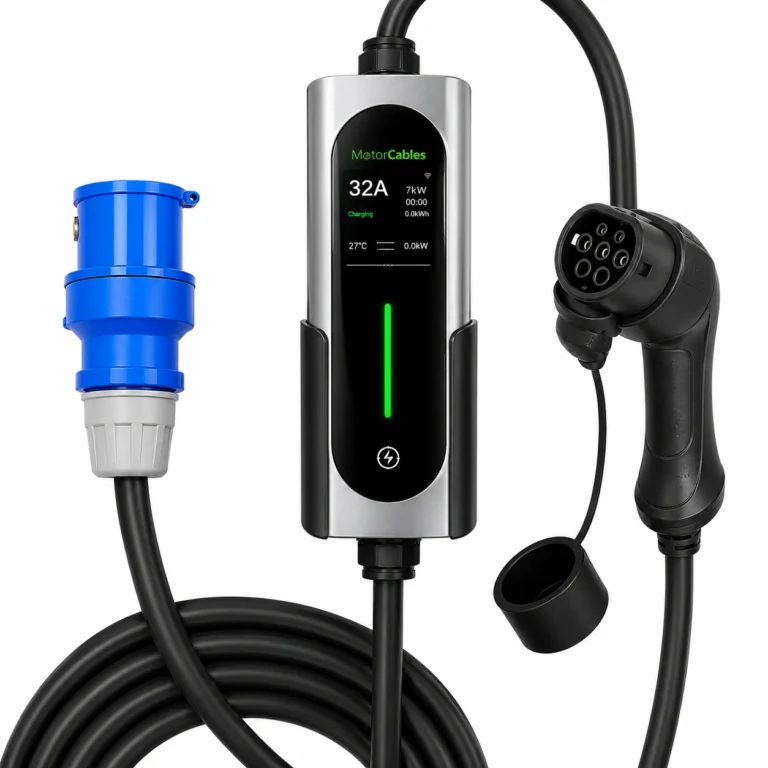
Our 32A single-phase portable Type 2 EV charger with WiFi and Smart Life app brings those roles together in one portable unit. It is worth considering if you want a charger you can keep ready at home and take with you when a suitable charging supply is available elsewhere.
Why adjustable current matters
The charger offers 6A, 8A, 10A, 13A, 16A, 20A, 25A and 32A settings. Adjustment is available through its button or the Smart Life app. The maximum setting is an option for an appropriate supply, not the setting to use automatically wherever you plug in.
For example, a connection limited to 16A cannot support a 32A charging setting. You may need a lower setting still, depending on the permitted load and equipment instructions. An adapter changes the physical connection; it does not upgrade the circuit behind it.
Adjustability makes the charger more flexible, but you still need to establish what a supply permits. Check that before starting a session and whenever moving to a different location.
A practical home charging arrangement
The supplied wall cradle gives the unit a home position, while its carry bag makes it convenient to pack for a trip. That is the appeal of this format: your charger can have a regular place without being permanently tied to that location.
Home use needs a supply assessed for EV charging. A socket marked 32A does not, by itself, establish that the circuit, earthing arrangement and protection are appropriate. Have a qualified electrician assess or provide the installation and confirm suitability for the exact charger.
Portable charging equipment does not remove those installation requirements. The IET’s EV charging installation guidance explains why the supply and its protective arrangements matter.
Taking the charger away
Before travelling, establish whether your destination permits EV charging and which supply you may use. A campsite hookup, a workshop outlet and an EV charging point are different facilities; do not assume permission or compatibility from the connector alone.
Ask about the available current and permitted charging arrangement in advance. Then check the charger instructions and any approved adapter requirements. This avoids arriving with the right-looking plug but the wrong equipment for the available supply.
For caravan and motorhome destinations, our hookup lead guide provides useful background. A pitch booked for leisure-vehicle power is not automatically permission to charge an EV.
Smart Life control and an on-unit display
The product includes WiFi and Bluetooth connectivity, Smart Life app support and a 2.8-inch display. The listing describes current adjustment and scheduling through the app, with charging information visible on the unit.
Check the app setup and scheduling instructions before relying on a routine. App control, the vehicle’s own charging settings and the permitted supply all need to work together. Consult the current product instructions for the available app functions and setup requirements.
What to check before buying
- Your vehicle: confirm its charging connection and permitted AC charging equipment.
- Your home supply: establish installation suitability with an electrician.
- Your travel plans: check permission, connection details and available current at each destination.
- Cable reach: the listed leads are 0.5m at the input and 5m to the vehicle; consider the actual parking layout.
- Outdoor conditions: the listing rates the charger body IP65. Plugs, sockets and other connections need their own suitable protection and handling.
Check the current product specification and availability before ordering.
Portable EV charger or Type 2 power converter?
They perform different jobs. This portable charger is equipment for charging a compatible vehicle from a suitable AC supply. A Type 2-to-CEE auxiliary converter takes power from a compatible charge point for another application. One should not be treated as a substitute for the other.
Read CP and PP explained to understand how the charging system communicates readiness and available current. Our EV adapter applications guide explains the different product categories.
Can you use a household socket or extra leads?
Do not assume that any household socket or converter lead is suitable for a long EV charging session. Use only arrangements permitted by the charger manufacturer and appropriate to the installation. Electrical Safety First advises using suitable EV charging facilities and highlights the importance of dedicated circuits and EV-rated socket arrangements.
See Electrical Safety First’s EV charging advice. A matching adapter is not a reason to ignore the charger’s restrictions or the supply assessment.
Explore the charger
If you want adjustable Type 2 charging equipment that can have a regular place at home and travel with you, view our 32A portable EV charger with Smart Life app for its full specification, current price and ordering options.
Ask Ashford can help you find the product and related catalogue information. For installation suitability, use a qualified electrician who can assess your supply.