A generator hookup lead connects the generator’s outlet to compatible equipment or a distribution unit. Start with the outlet markings, the equipment requirements and the cable route. Generators have different voltages and connector arrangements, so there is no universal lead.
For the difference between a three-phase generator supply and its phase-to-neutral outputs, read our Three-Phase Power Explained beginner’s guide.
Identify the outlet before choosing a lead
| Supply arrangement | Typical use | What to check |
|---|---|---|
| 110V site supply | Compatible tools and site lighting, commonly using yellow industrial connectors. | The exact voltage, current rating, pole arrangement and site specification. |
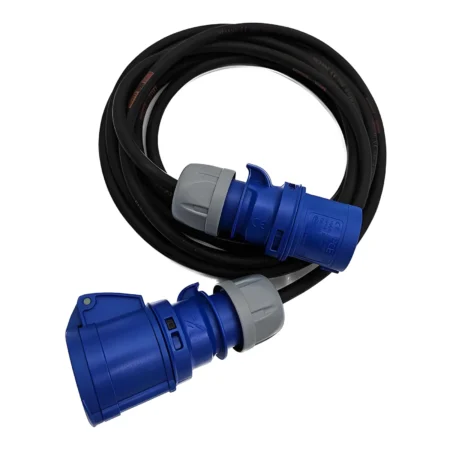
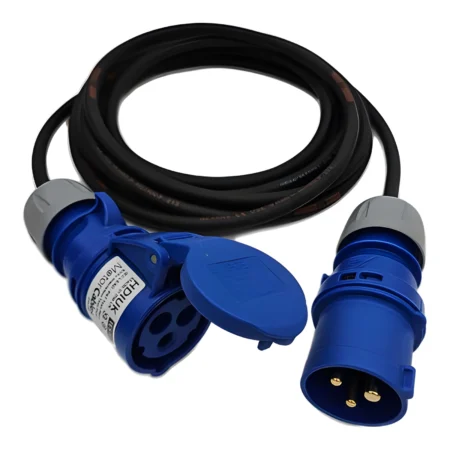
| 230V single-phase supply | Suitable appliances, leisure equipment or temporary distribution, often using a blue CEE connection. | The generator’s available output, matching connectors and the load to be supplied. |
| 400V three-phase supply | Suitable machinery or distribution equipment, commonly using red industrial connectors. | Phase arrangement, whether neutral is required, current rating and the complete distribution design. |
Colour helps identify a connector family but is not a complete specification. Read the markings and generator instructions. Our industrial connector guide explains plugs, couplers, poles and clock positions; three-phase power explained covers phase-to-phase and phase-to-neutral voltages.
16A and 32A site connections
A 16A 110V yellow site lead is for a matching 16A connection and suitable load. A 32A 110V yellow site lead has a different connector rating and must match the specified supply arrangement. A larger-looking lead does not upgrade the generator or make unlike connectors interchangeable.
Browse the 110V site service range against the requirement provided for the site. For construction tools and site supplies, read construction-site power leads.
230V and three-phase generator leads
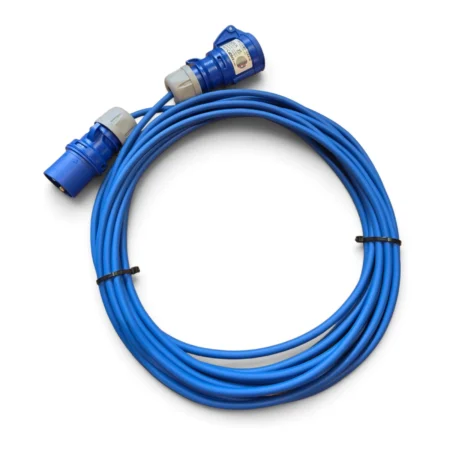
For a suitable 230V outlet, compare our blue CEE 16A lead range with the generator and equipment specifications. A motorhome hookup is a separate application: its onboard installation and the generator supply must be suitable for one another. The motorhome hookup guide explains the vehicle-side checks.
For a generator with a suitable three-phase outlet, use a correctly specified three-phase lead or distribution connection. Check the required conductors as well as the current rating. A passive adaptor cannot create a neutral that the supply does not provide.
Choose the cable and route
Measure the actual route, including access around equipment. Choose a cable construction suitable for the environment, handling and required load. Keep connections protected from damage and water, and manage crossings and trip hazards.
Read the Arctic and H07RN-F cable comparison for materials and markings. For longer runs, use the voltage-drop explanation and calculator; voltage drop is one part of selecting a suitable complete arrangement.
Earthing and protection are separate from connector fit
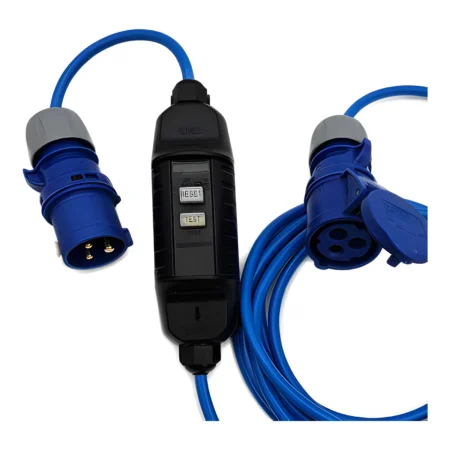
A lead with matching connectors does not establish that a generator’s earthing, bonding or protective devices suit the connected equipment. Use the generator manufacturer’s instructions and the electrical design for the complete setup. Our neutral–earth bonding guide explains floating outputs and why a bonding plug is not a universal fix.
What to send when ordering
- Generator make, model and clear outlet photographs, including its markings.
- Equipment or distribution-unit input requirements.
- Voltage, current rating, connector and required conductors.
- Measured cable route, environmental conditions and any prescribed cable specification.
Send MotorCables your cable requirement for help identifying a listed lead or discussing a custom assembly. For event distribution, continue with event and stage power cables. Generator selection, electrical system design and verification require the appropriate competent person.