
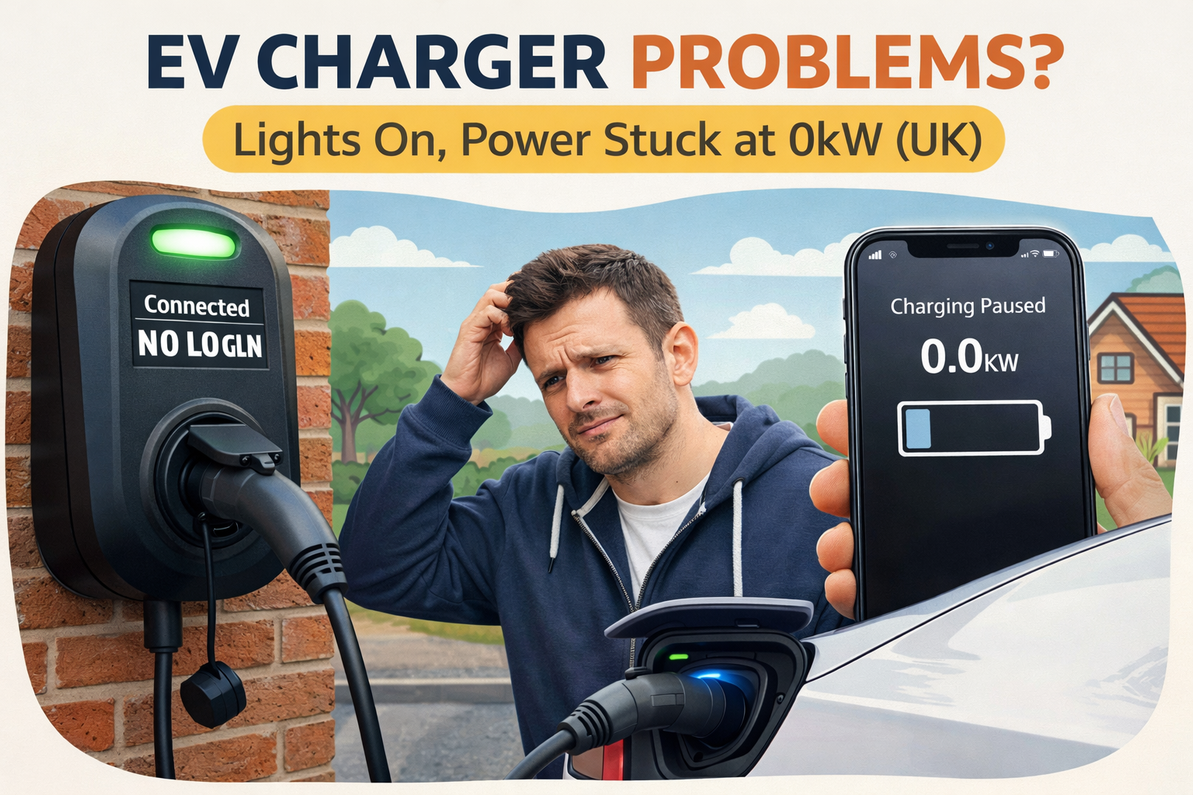
Why Your EV Won’t Charge When You Plug It In (New-Build Smart Charger Off-Peak Explained)
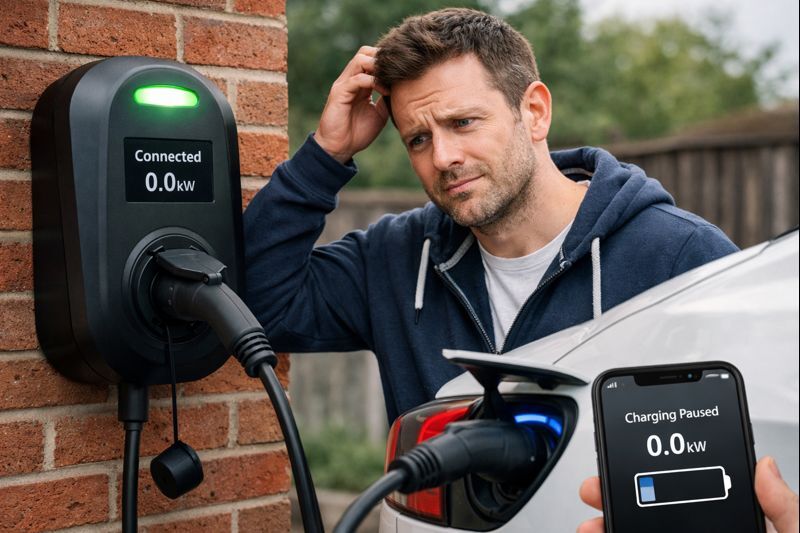
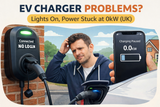
If you plug your EV in and the charge point lights change (so it clearly detects the connection), but no power flows and your app shows 0 kW, you’re not alone. In most cases, nothing is broken — your charger is simply waiting for a scheduled start time.
The 10-second answer
Many modern UK home EV chargers are configured to charge during off-peak hours by default. So you can plug in, see lights change, and still get no charging until the programmed window begins (sometimes with a short random delay too).
The exact symptom we’re talking about
- You plug in and the charger shows connected (lights change / lock engages / app shows “plugged in”).
- The car shows connected or waiting.
- But the charger delivers 0 kW and the car doesn’t start charging.
- No obvious error message. No fault light. Just… nothing.
This is the “brick wall” moment: everything looks alive, but you’re getting no power.
The #1 UK cause: smart charging schedules (off-peak by default)
A lot of newer UK home chargers are smart chargers. In plain English: they can be scheduled and controlled to protect the grid. The practical side effect is simple — your charger can detect the car (lights change) but wait for off-peak hours before delivering power.
Some chargers also introduce a short “random delay” so a whole street doesn’t switch on at exactly the same moment. That’s why waiting up to 10 minutes is sometimes a valid test.
New-build problem: no app access = no override
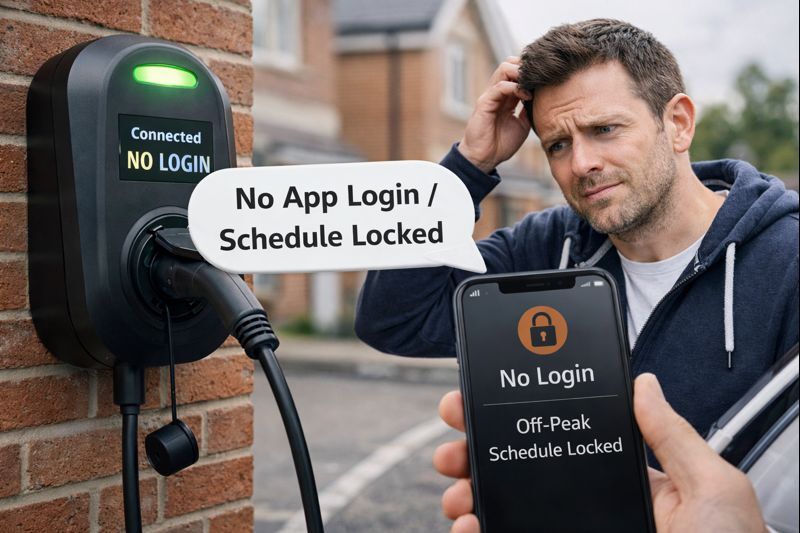
This catches people out constantly on new builds. The charger is fitted and powered, but the homeowner hasn’t been given the proper handover details (app pairing/admin access/onboarding). Without that access, you can’t easily override the default schedule — so it looks broken when it isn’t.
If you’ve moved into a new build and charging won’t start, ask the developer/installer for the charger handover details. Until then, it may remain stuck on its default off-peak program.
Fast checklist: what to try before you panic
- Disable the car’s charging schedule (many EVs have one).
- Check the charger app for off-peak / eco / timed settings (if you have access).
- Use “Boost / Charge Now” if your charger has it.
- Wait up to 10 minutes in case your unit applies a random delay.
- New build? Confirm you have the charger handover / app pairing details.
Why this happens: rules and unintended consequences
Most people don’t understand electricity — and they shouldn’t have to. But EV charging now involves schedules, apps, tariff controls and remote settings just to get power flowing. A lot of policy focuses on environmental targets and grid modelling, but often misses the real-world user experience: people expect “plug in = charge”.
Energy companies also have incentives to push charging into off-peak windows: it helps manage grid load and can align demand with cheaper spot pricing. That might make sense at system level — but it leaves normal homeowners confused if nobody explains it during installation/handover.
How MotorCables discovered this (real customer calls)
We didn’t learn this from a policy leaflet — we learned it from customers. People started calling after using our Type-2 socket converters . They’d plug in, the charge point lights would change immediately… but no power would come through.
After checking the equipment, we realised many chargers were simply waiting for scheduled charging windows. That’s why this guide exists: to get you out of that “brick wall” moment fast.
Need clarity in 60 seconds?
Ring Jim at MotorCables. We’ll tell you what’s happening and what to check (no waffle).
0333 344 9792 | 07940 956114
Important compatibility note: Type-2 AC vs CCS/DC rapid
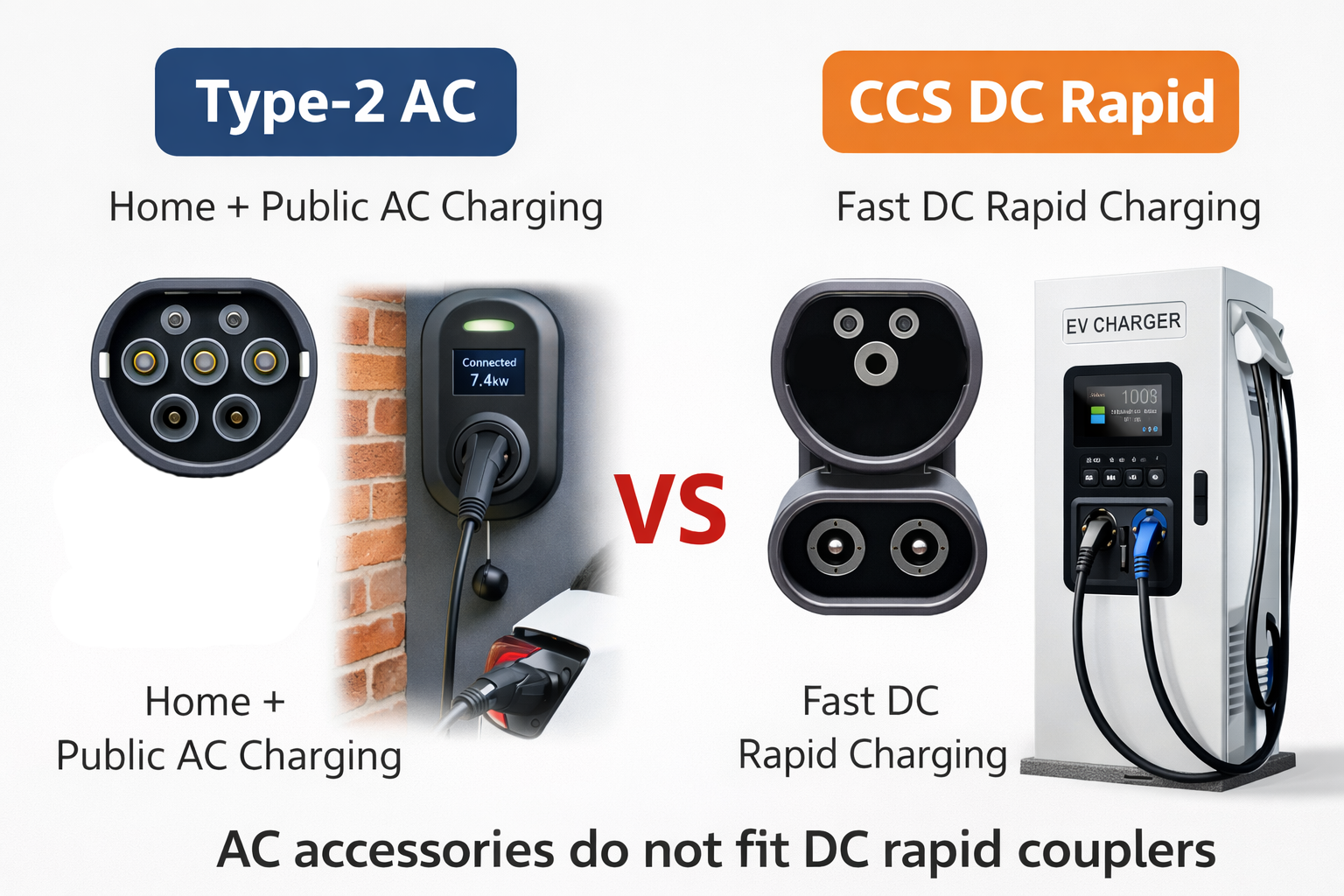
Type-2 AC (home charging and many public AC posts) is not the same as CCS/DC rapid charging. DC rapid chargers use a different electrical system and connector standard. If you’re unsure what you’re looking at, call Jim before you waste time.
MotorCables EV products (plus real support)
- Type-2 socket converters (turn Type-2 AC sockets into usable mains power)
- EV charging cables (Type-2 leads, extensions & heavy-duty options)
- Home EV charge points (chargers & accessories)
Frequently Asked Questions
Why does my EV charger show lights but my car stays at 0 kW?
Usually a schedule is active. The charger detects the vehicle (lights change) but waits for off-peak hours or a programmed start time before delivering power.
Why do new-build home EV chargers often not start charging immediately?
Many chargers default to off-peak schedules and require app pairing to override. On new builds, residents sometimes aren’t given app/admin access straight away.
What should I check first if my charger is on and connected but not charging?
Disable your car’s charging schedule, check the charger app for off-peak/timed modes, try “Boost/Charge now”, allow up to 10 minutes for any delay, and confirm app access.
Can my electricity tariff or energy provider settings delay EV charging?
Yes. Some chargers integrate with tariffs and grid-smart settings and will delay charging until cheaper or permitted windows unless you override with “Boost/Charge now”.
Who can I call if I’m stuck and want a plain-English answer?
Call Jim at MotorCables on 0333 344 9792 or 07940 956114.
What’s the difference between Type-2 AC and CCS DC rapid chargers?
Type-2 AC is used for home charging and many public AC posts. CCS is DC rapid charging and uses a different system. AC accessories do not work on CCS/DC rapid couplers.
HDIUK LIMITED trading as MotorCables.co.uk. For technical advice on EV charging behaviour, compatibility, cables and adapters, call 0333 344 9792.
Recent Posts
-
Why Your EV Won’t Charge When You Plug It In (New-Build Smart Charger Off-Peak Explained)
If your charger lights change but the car stays at 0 kW, it’s usually a schedule/app setting — …29th Dec 2025 -

HDIUK Smart Breaker for Villas, Homes, Campsites & Hot Tubs
Smart Energy, Real Results – How the HDIUK Smart Breaker Is Transforming Power Control Electricity …24th Oct 2025 -

How to Use EV Chargers for Real Power – The Ultimate Guide to Type 2 Adapters
Type 2 Power Adapters Explained – 7 kW, 11 kW & 22 kW Compared Whether you’re a motorhome owner, …17th Oct 2025